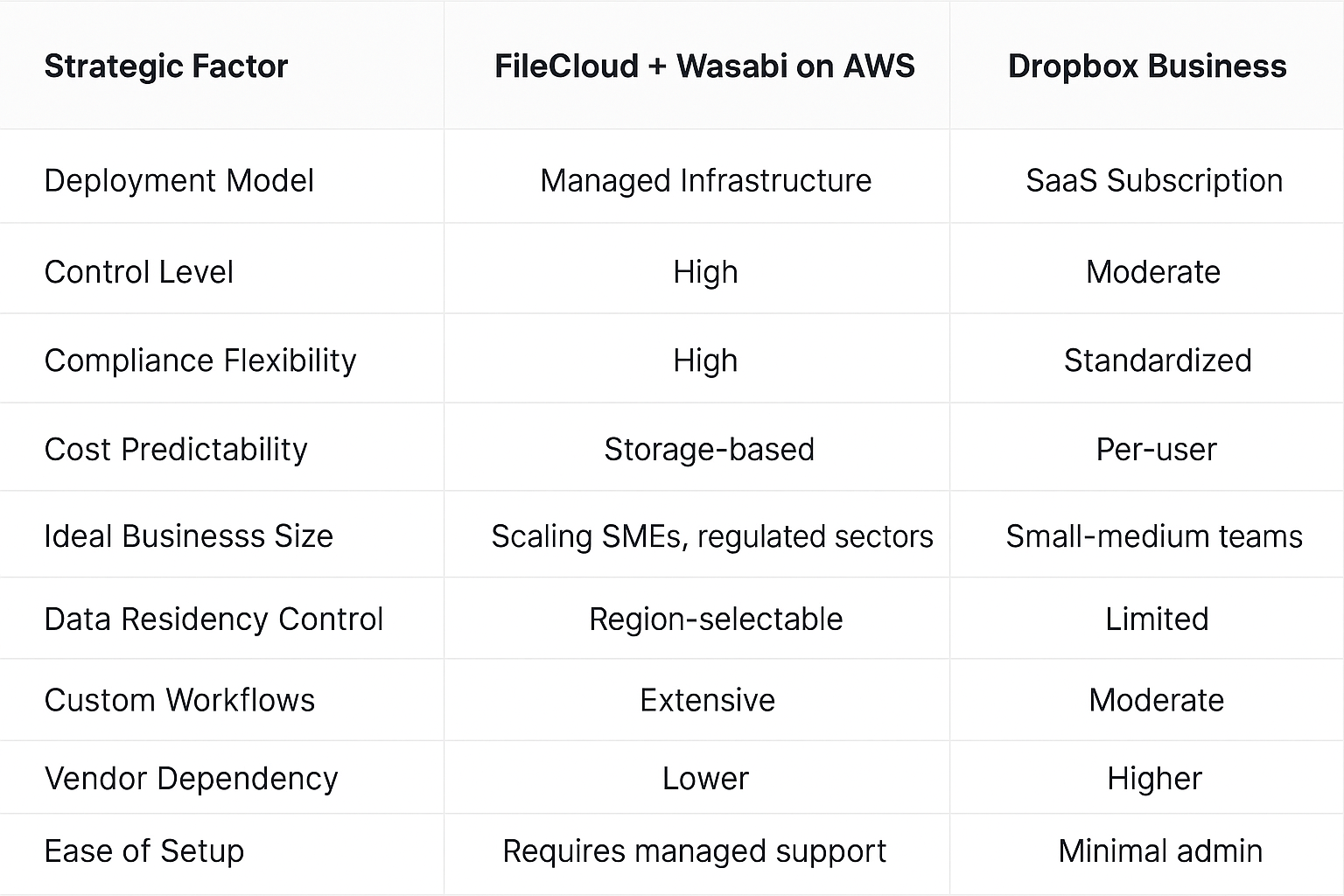
FileCloud + Wasabi on AWS vs Dropbox Business
Managed Cloud Infrastructure vs SaaS File Sharing: Strategic Trade-Offs for UK Organisations
Cloud storage has evolved far beyond simple file syncing. For UK businesses operating in regulated, security-sensitive, or growth-focused sectors, the decision between a managed cloud infrastructure stack and a fully hosted SaaS platform is no longer purely technical, it is strategic.
Many SMEs default to platforms like Dropbox because of simplicity and brand recognition. However, as organisations scale, face compliance requirements, or demand deeper administrative control, SaaS convenience can become limiting.
An alternative approach is deploying enterprise file management software such as FileCloud hosted on infrastructure like Amazon Web Services, with object storage powered by Wasabi. This model blends enterprise control with scalable cloud economics.
This insight explores how these two approaches differ in cost predictability, data sovereignty, compliance flexibility, performance, and long-term strategic control.
The Strategic Difference: Infrastructure vs Subscription
At a high level, the distinction is this:
Dropbox Business = Fully managed SaaS subscription model
FileCloud + Wasabi on AWS = Managed cloud infrastructure model
The SaaS approach prioritises simplicity and rapid deployment. Infrastructure-backed deployments prioritise control, policy flexibility, and architectural ownership.
For early-stage teams, SaaS works well. For regulated, scaling, or security-sensitive organisations, infrastructure-based storage increasingly becomes the more resilient long-term strategy.
Data Sovereignty & Compliance
UK organisations operating under GDPR, FCA guidance, healthcare frameworks, or legal confidentiality obligations often require clarity on:
Where data physically resides
Who controls encryption keys
How audit logs are retained
Whether retention policies can be customised
Infrastructure Model (FileCloud + Wasabi on AWS)
Region-specific deployment (e.g., UK/EU AWS regions)
Configurable retention policies
Advanced audit logging
Greater control over encryption configuration
Reduced dependency on vendor data architecture
SaaS Model (Dropbox Business)
Managed infrastructure
Limited regional hosting guarantees
Standardised retention frameworks
Vendor-controlled encryption management
Insight: Infrastructure models provide greater compliance adaptability for firms with regulatory exposure.
Cost Structure & Scalability
Cost comparison is often misunderstood.
Dropbox Business
Per-user subscription pricing
Tiered storage limits
Costs increase linearly with headcount
Additional advanced security features may require premium tiers
FileCloud + Wasabi on AWS
Storage billed per TB (object storage model)
Infrastructure scaling independent of user count
Predictable storage pricing
Management/support layered transparently
Strategic Impact: High-growth companies often find per-seat SaaS models more expensive over time compared to storage-based infrastructure models.